
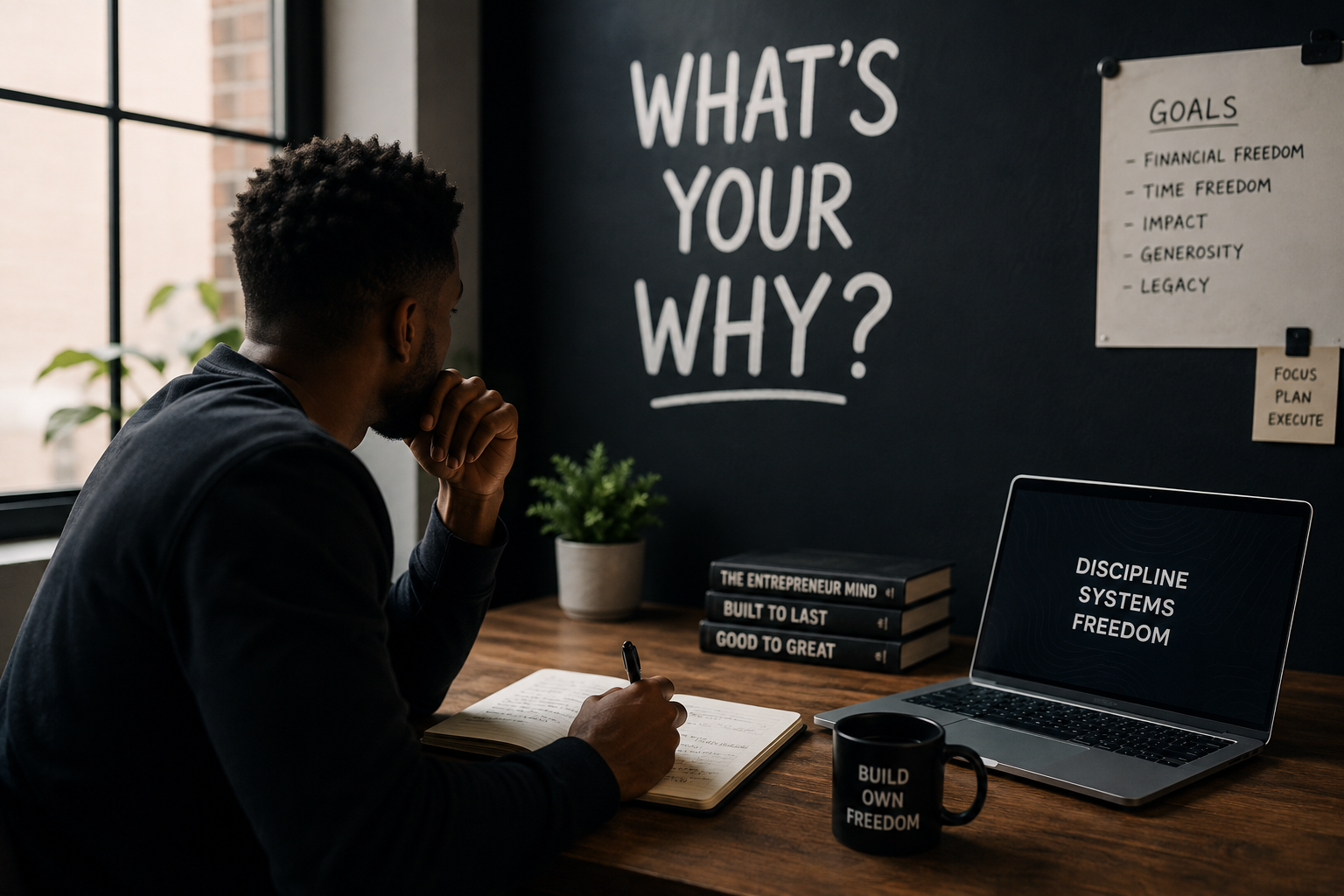
Simon Sinek popularized a simple but powerful idea: start with why. His argument is that people are more inspired by the purpose behind what we do than simply the products we sell, the services we provide, or the jobs we perform.
That same thinking applies to entrepreneurship.
Ask someone why they want to start a business and financial freedom will probably come up somewhere in the conversation. But “financial freedom” has become one of those phrases we use so often that we rarely stop to define it. Does it mean becoming wealthy? Quitting your job? Retiring early? Traveling whenever you want? Never worrying about another bill?
Maybe. But I think there's a more useful definition: financial freedom is having options.
It's being able to make decisions about your life without every decision being dictated by your next paycheck. Once you look at it that way, entrepreneurship becomes less about escaping a job and more about building ownership, leverage, and additional sources of income.
Your Job Doesn't Have to Be the Enemy
Entrepreneurship gets romanticized. We're constantly shown stories of someone quitting their job, betting everything on an idea, and eventually building a successful company. That's one path, but it isn't the only one, and for many people it isn't even the smartest one.
Your career can actually be part of your entrepreneurship strategy.
A job can provide steady income, benefits, experience, relationships, and the capital you need to build something outside of it. You can use the stability of your career to take calculated risks instead of desperate ones. The goal doesn't necessarily have to be getting rid of your paycheck as quickly as possible. A better goal may be making sure that paycheck isn't the only thing holding your financial life together.
That's an important distinction. If losing one source of income would completely disrupt everything, you may be earning good money, but you don't necessarily have financial freedom yet.
Entrepreneurship gives us an opportunity to start changing that equation. And today, there are more ways to develop your own business than the traditional idea of simply starting one business and hoping it succeeds.
From Earning to Owning
Most of us grow up learning a fairly straightforward financial model: get an education, build a career, earn more over time, save some of it, and hopefully retire comfortably.
There's nothing inherently wrong with that model. The limitation is that most earned income is directly connected to our time. You perform the work and receive compensation for it. Even with a great salary, there are only so many hours you can work and only so much of yourself you can give.
Ownership changes the equation.
A business is something you can own. Intellectual property is something you can own. Digital products, software, investments, real estate, brands, and other assets can all create value beyond a single hour of your labor.
That doesn't mean “passive income” magically appears because you registered an LLC and built a website. Most businesses require a tremendous amount of work, especially in the beginning. But the objective begins to shift.
Instead of constantly asking, How can I make more money? you start asking, What can I build or own that creates value over time?
That's a much more interesting question.
And one business doesn't necessarily have to be the final destination. A service business might generate the cash flow to develop a product. Consulting can lead to software. A side business can generate money that gets invested elsewhere. One successful project can create relationships that open the door to an entirely different opportunity.
Over time, you aren't simply collecting side hustles. You're building an ecosystem of assets, income streams, skills, relationships, and opportunities that reinforce one another.
The Barrier to Building Has Changed
Technology has made this approach more accessible than it has ever been.
Not long ago, launching a legitimate business could require significant upfront infrastructure. Today, an entrepreneur can build a professional digital presence, accept payments, manage customers, automate repetitive work, sell products, communicate with clients, and operate sophisticated business systems without a huge team or enormous amount of capital.
AI has accelerated that shift even further. It can help with research, operations, content, customer service, analysis, development, and countless other parts of running a business. Cloud platforms have made powerful technology available to businesses that would never have been able to afford their own infrastructure.
None of this removes the need for a good business model or good execution. Technology can't manufacture demand for something nobody wants, and AI doesn't magically turn a bad idea into a profitable company.
What technology has done is lower the cost of trying.
That's significant because entrepreneurship doesn't always need to begin with some dramatic leap. It can begin with an experiment: one client, one service, one product, one website, one idea tested in the real world.
You learn. You adjust. You build from there.
And when that idea starts becoming a real business, your digital foundation matters. A website should be part of your business infrastructure, not just something that looks good online.
Don't Build Yourself Another Job
There is another side to this conversation that doesn't get discussed enough. Starting a business does not automatically create freedom.
Sometimes it creates the exact opposite.
If every customer needs you, every decision requires you, every sale depends on you, and every problem eventually lands on your phone, you've created income, but you haven't necessarily created leverage. In some cases, people leave a 40-hour job only to build themselves an 80-hour one.
That's why systems matter.
As a business matures, the question has to evolve from How do I do all of this? to How should this work?
Processes can be documented. Repetitive work can be automated. Technology can eliminate unnecessary administrative work. Responsibilities can be delegated. Customer experiences can be standardized. Revenue can become more predictable.
The goal isn't to remove yourself from everything you build. It's to make sure everything you build doesn't collapse the moment you step away from it.
That's where entrepreneurship starts becoming a vehicle for freedom instead of simply another way to stay busy. It's also why we focus so heavily on building the systems behind the business, not just the customer-facing pieces.
Start With What You Have
You don't need the entire roadmap before you begin.
Start with what you already have: your experience, your skills, your relationships, the problems you understand, the industries you know, and the technology available to you.
Maybe your goal is to provide more for your family. Maybe it's control over your time. Maybe you want to build generational wealth, fund other ideas, invest in your community, or reach a point where money isn't controlling every decision you make.
Whatever it is, your reason doesn't need to sound profound to anyone else. It just needs to matter to you.
Financial freedom probably won't come from one perfect business idea. More often, it's built through a series of smart decisions made over time: earning, saving, investing, building, owning, learning, and creating additional opportunities.
The goal isn't necessarily to build the biggest company possible. It's to build enough ownership, income, systems, and opportunity that you have choices.
Entrepreneurship is one way to do that.
And there isn't one path that works for everyone. Some people build businesses from scratch. Some create products or brands. Others leverage business planning, education, and mentorship for their own ventures. What matters is understanding what you're actually trying to build and choosing a path that supports it.
Before you worry about the business name, the logo, the website, the LLC, the revenue goal, or everything else that comes with building something, there's a more important question to answer first.
So, what’s your why?